Wednesday, January 21, 2015

What super-power does your food have?


Healthy food fuels the body. We know this as adults, but how do we get kids interested without boring them with the science behind vitamins and minerals found in food and their benefits on the body? Well, I've been trying out a new phrase with kids... 
What super power does your food have? 
In the lunch room I am always encouraging kids to add vegetables and fresh fruit to their plates, telling them what "super power" each food has. Soon kids have realized that some food (healthy food) has super powers, while some food has nothing (sugary/ white foods). They love to show off their healthy foods, and I love reminding them what each food can do for their body.

Here are a couple of great articles about getting kids to love healthy foods:

http://blog.williams-sonoma.com/turn-superfoods-into-superpowers-for-kids/

http://summertomato.com/11-proven-ways-to-get-kids-to-eat-more-vegetables/


Vocabulary Words this Week

Past
Present
Future
Century
Entertainment


Friday, December 19, 2014

Happy Holidays!

Wishing you and your family the most joy filled winter vacation! I will be thinking of you all and counting down until January 5th! 

Quick Language Development Tips!

http://eclkc.ohs.acf.hhs.gov/hslc/tta-system/teaching/docs/expansions-family-tips.pdf


Monday, December 15, 2014

Passport Club

Each month's locations are now posted on the PTA website, in case you need them. Our next check day isn't until January.


http://benrushpta.org/geography-programs/

Pajama day on Friday!


On Friday the 19th, send your child to school in his/her favorite pajamas! We will have a fun and cozy last-day-before-break!

Monday, December 1, 2014

New words 12/1

Locate, height, route, model, separate 

Wednesday, November 19, 2014

Words this Week

Enjoy, admire, connections, leadership, rely

Monday, November 17, 2014

FYI

No After-School Classes Thanksgiving Week

Don't forget that after-school classes will not be held the week of Thanksgiving, Monday through Friday, November 24th to November 28th.

Thursday, November 13, 2014

Doubles!


Kids need to memorize their doubles by the end of the week! Please practice at home to help us accomplish this goal.

Wednesday, November 12, 2014

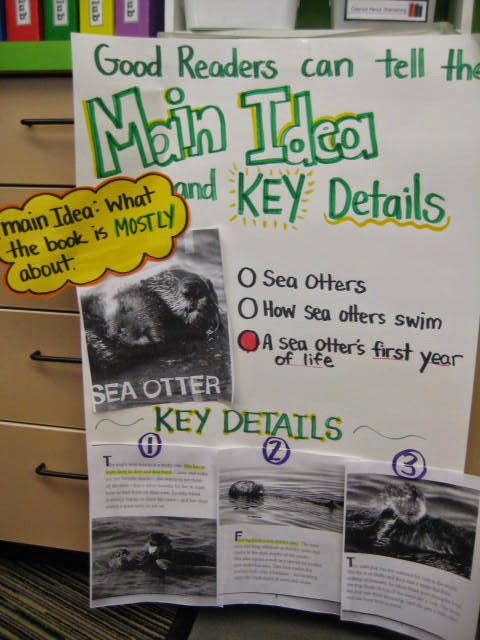
Main Idea and details

One of the most important reading comprehension skills kids should master by the end of first grade is to recall the main idea and important details from a text. Here are the standards below from the Common Core:

Key Ideas and Details:

CCSS.ELA-LITERACY.RL.1.1
Ask and answer questions about key details in a text.
CCSS.ELA-LITERACY.RL.1.2
Retell stories, including key details, and demonstrate understanding of their central message or lesson.
CCSS.ELA-LITERACY.RL.1.3
Describe characters, settings, and major events in a story, using key details.

Here is a chart we made together to help solidify this skill: 

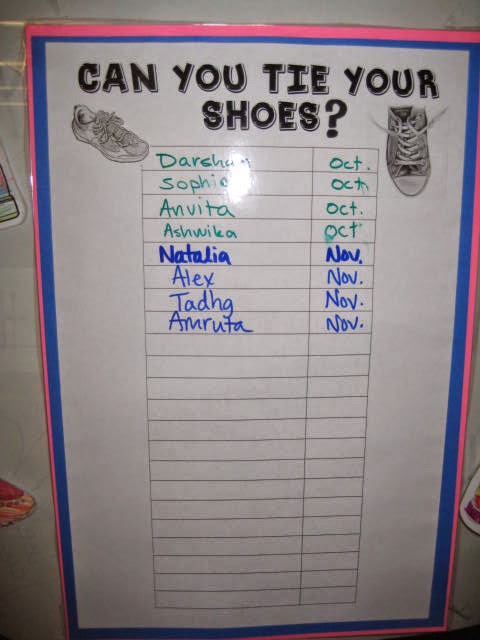
Inspiring 1st grades to learn how to tie their shoes

In our class I have a challenge for all 1st graders. To learn how to tie their shoes at home! Here is an example of one of the many ways to learn. Good luck!

Thursday, November 6, 2014

New vocabulary words

Hibernate, tolerate, tranquil, depend, habitat 

Friday, October 24, 2014

Tuesday, October 21, 2014

Art Teacher Needed!

Our school has a wonderful art docent program ran by parent volunteers who help prepare and/or teach lessons to classes. See http://benrushpta.org/pta-programs/art-docents/ if you are interested in being our class's art docent!

Great Way to Help Kids Build Routines at Home

I found this awesome website that allows you to print visual prompts to help your child through routines that may otherwise be a struggle. Maybe they might work for your child, or even a younger sibling!

http://www.livinglocurto.com/2009/08/school-morning-routine-free-printable-cards/

Thursday, October 16, 2014

Helping Kids Deal with Anger


Learning to manage strong emotions such as anger is challenging, especially for children! The best way to help children deal with anger is to talk about it & teach about it. Encourage kids to talk about their feelings, say when they are feeling angry or frustrated. Then teach them ways to "cool-down" before they react to the challenging environment. I found this blog that listed several books to help kids deal with anger, and I thought I'd pass it along if you are interested in learning more or finding books for your child.

http://kidlutions.blogspot.com/2012/03/books-that-help-kids-deal-with-anger.html

Click the above link

Wednesday, October 15, 2014

Words this week & NEXT

Astonishing, fortunately, equipment occupation, community


Monday, October 6, 2014

Our New Words

Each week we learn 5 new vocabulary words. We talk about these words every day in class so that they may transfer the use of these words in their daily lives. Remember these are NOT spelling words, just words to use in their oral vocabulary, and written work. This week our words are:
physical, exercise, agree, difficult and exhausted.

Tuesday, September 23, 2014

Story Time

Story time is extremely important in the growth of language, comprehension strategies, and the development of story structures (for writing or telling). In my class I read, react to the story, ask questions, ask students to make predictions, talk about the emotions inferred by pictures or text clues, etc.
At Columbia University, they call these "Read Alouds with Accountable Talk." Reading this way, is so much more than reading words on a page. See below for some information I have from the Teacher's College at Columbia University.

"Teachers use ‘think alouds’ as opportunities to model that strong readers don’t just read the words but also think about the story. For example, if you stop in the middle of a chapter and say, “I can’t believe the character is acting this way. I wonder why she’s being like this…” you demonstrate to your students that readers question the characters and wonder about their motivations. If you think aloud by saying, “I bet she’s going to lose the bracelet,” you model that readers make
predictions as they read. When you say to your class, “I want just to reread that part again. I was
daydreaming and lost the story,” you teach that rereading is a strategy, readers reread to regain
comprehension.
 Besides thinking aloud, you will provide opportunities throughout the book for children to turn
and talk to each other about the text. Prompt the class by saying something like, “Turn and tell your
neighbor what you think will happen next,” or “Let’s think about what’s going on here. Turn and talk to your neighbor about what you think (so and so) is thinking right now.”
To prepare for the interactive read aloud, reread the text in a really thoughtful way. Spy on yourself as you read in order to notice a few places in each chapter where your brain does a lot of reading-work. Note those sections. Later, review each one. Ask, “Was I doing a lot of thinking here because the text is written in such a way that lots of readers will be thinking at this section? (or was your response totally idiosyncratic?) If the section of the text seems to ask for a thoughtful response, you may decide use this as an opportunity to teach:
• You may “think aloud.” This means you’ll pause at this section of the text and be pensive aloud.
“Hmmm… something weird is going on. It’s giving me the creeps!” you might say. Or “Why’s
he so mad? I’m going to read to find out.” Don’t say a lot… a line or two is usually enough. "

I hope this gives you some ideas about how to make read alouds more fun at home :)

Here are some stories we've been reading lately